Friday, July 31, 2015

Pattern Review - 2015 Historical Fashion Contest - Past Patterns 4998


Past Patterns 4998 made circa 2001 with floral rayon georgette
Oh lawdy! I had entered this contest, and was so short on time to complete it!! If you don't know about PatternReview.com, they are a website with thousands upon thousands of members with varying sewing experience. You can find reviews of all sorts of patterns, sewing machines, and even find a tutorial or two. They hold monthly contests, and this was my first entry into one.

This contest was for any costume reflecting any period of fashion from the 1920s and earlier. Most likely I will not win as my little dress is competing against Renaissance era gowns, etc with tons of detail and layers. Here is the Gallery of all those that entered. Either way, it was a good way for me to get my feet wet in the whole experience, and as Brando once said....I coulda been a contenda!!! LOL

Because I was short on time, I stuck with a pattern I had worked with before: Past Patterns 4998 - 1929 Slip On Evening Frock and Bolero Jacket. Past Patterns is a wonderful resource for authentic past decade patterns (1940s-1780s) that have been reproduced for sale at a very fair price!


Since I had worked with this pattern before, I knew I could whip this out pretty quickly in the time frame I was working with....1 whole day!! I used a midnight blue (almost black) poly chiffon lined with a linen blend peach shantung. I had to make a slight alteration to the skirt pieces and my chiffon. The skirt pieces are supposed to be cut on the fold, but I didn't have enough of my chiffon. To compensate, I cut the pieces with a small center seam on both the front and back skirts.

The neckline and armholes are finished with bias tape. Attaching the skirt to the bodice is the only difficult part of this pattern. When pinning the right sides together, the bodice has an 'arch' shape while the skirt has a 'U' shape. I sewed most of this area on the machine, taking it slow to move any full ease out of the way and making sure my bodice underneath wasn't folding up. I then hand sewed the side hip area where all my pieces met.

The result was pretty stunning, although I wish I had had time to do some beading and/or appliques.


Voting ended on August 9th, and with the final stats now posted, I placed 8th out of 18 garments. Honestly, that is much better than I thought I would end up. Congrats to the winners and all those that participated. I get inspiration from seeing what other people create, so something like this is always a win-win for me. Well....on to the next contest for August ~~ The Inspired by Books Contest!


Saturday, July 25, 2015

Cocktail Rebel - Butterick 5603 (sort of)

My second dress for the Cocktail Rebel event was made for, and worn, by my life long gal-pal Kassy. When asked what she wanted to wear to the event, she sent me this picture.
 

She wanted a high neckline, so looking through my pattern stash, I found Butterick 5603.


Originally, I had wanted to turn the skirt panels into box pleats, with gussets placed in between each at the waistline. After reading many reviews on this dress pattern, I constructed my muslin with the changes I wanted to make. As many  had previously reviewed, the fit through the waist was very poor. I ended up keeping the bodice, and scrapping the rest of this pattern. I drafted a midriff piece, then drafted my box pleat panels and gussets.

The pattern had a band and bow at the front neckline, but I ended up taking my contrast material and draped a faux-scarf. I also scrapped the underbust band, but kept the bow.

In lieu of the lining on the bodice, I constructed another shelf bra by duplicating the bodice and adding a 1" elastic band cut 1" short of Kassy's under bust measurement. An elastic bra hook was placed on the elastic band, at the side opening.

I sewed the shelf bra and dress together like a lining at the neckline, then top stitched. The arm straps were way too thin to construct as a regular lining and to be able to turn everything inside out like I would need to. Because of this, I kept the shelf bra and dress armholes together, and finished with single fold bias tape.

I would have taken more pictures during the construction of this dress, but this was one of those pieces I kept running into issues with. So many, in fact, I was not even sure I was going to be able to finish it in time. Many of these issues were due to my mistakes more than anything else. If you've been sewing for a while, that is just how some projects go!

Once I was on more solid footing with this project, I decided to add two scarves to the back, continuing the drape of the front neckline. I drafted the pieces, gathered them at the shoulders, and let them hang freely to the length of the dress. This was absolutely the perfect touch!

All the frustrations were worth it as she looked absolutely beautiful for our event!!


Cocktail Rebel - Butterick 5882 - Cha Cha's Dress

Cocktail Rebel was a Rockabilly event at the beautiful McNay Art Museum. Upon deciding to attend with two of my girlfriends, I asked them what they wanted to wear. My BFF sent me a picture of Cha Cha's prom dress featured in the movie "Grease".


I had Gertie's retro pattern, Butterick 5882, that I had been wanting to try.


I wanted to keep the ruffles from the Cha Cha dress, at the bust. I pulled out a damaged vintage peignoir set that I was saving for such a project.


I had also recently snagged some small shoulder pads at a thrift store, and immediately thought I would try something new. I wanted to place a shelf bra in the dress with padding at the bra cups. I decided to sew the shoulder pads together to make a full circle. I then added elastic, slightly stretched, around each top half of my 'cups' to ensure coverage and give each a more natural shape.

I then encased each cup in the peignoir fabric, and hand sewed the peignoir ruffle collar to the areas of the cups that would be exposed. My shelf bra was made by taking the bodice pieces to slightly below the bust area. I used a thin, lycra poly knit and added a 1" elastic band, cut 1" short of my my BFF's under bust measurement. I then added an elastic bra hook to the back.

 
I sewed the top of the shelf bra to my main fabric like a would a lining, leaving the center back unattached. Once all was placed together, and my zipper was placed, I then hand sewed my bottom bust ruffle trim, securing the outside dress to the bra cups to prevent separation of the pieces while in wear

One additional change was that I changed the arm straps into a halter.

I could not be happier with the end result, and my BFF was gorgeous!!
.


Thursday, June 4, 2015

A Brief Fashion History Part 3: The 1930s

The stock market crash, known as Black Tuesday, occurred in November of 1929. The over-indulgent 1920s suddenly halted to a new stark reality of economic vulnerability. The 1930s saw two broad spectrums in fashion, one of glamour and the other born of poverty in what is known as The Great Depression.

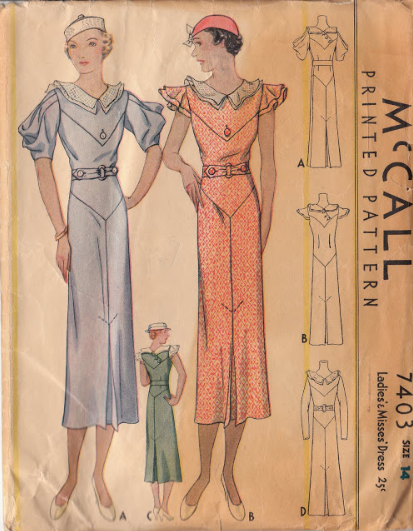
Fashion of the 1930s saw the birth of the tea dress. Dresses became more contoured, waistlines rose, and hemlines dropped to mid to lower calf or 'tea length'. These were often made of chiffon and adorned with ruffles (a.k.a. jabots), flutter sleeves, and the art deco beading of the 1920s was now seen in interesting deco seam lines.

Day dresses saw interesting, higher necklines, bows, single pleated skirts, and puff sleeves often made of linen.

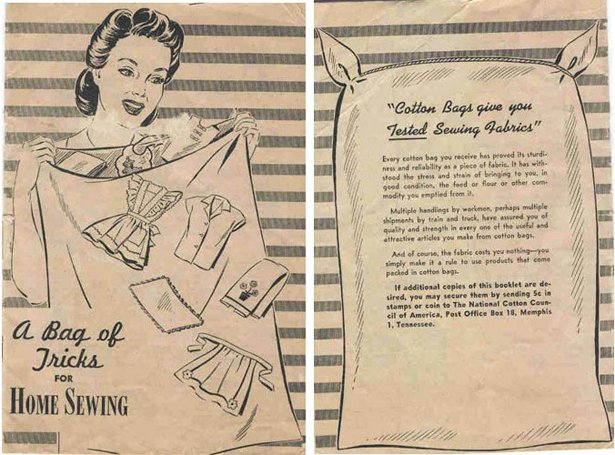
The tea dress and day dress are general changes seen in the 1930s. As mentioned previously, this time period in the U.S. experienced economic disparity. The market crash was just the beginning as those in the mid-west were suffering from a record long drought. Farmers had over planted, depleting the once rich soils. With no modern forms of irrigation, nutrient depleted lands, and long periods of drought, farmers literally saw their crops turn to mere dust in what is referred to as The Dust Bowl. Feed supply companies found it more difficult to sell their goods, and came up with the idea of packaging feed in floral printed cotton sacks. Sales rose as families re-purposed these bags into clothing and other household necessities. Thus came the entry of the 'feedsack dress'.

These dresses were cotton, so they were easy to care for, and usually had a small floral (a.k.a. calico) print.

Even farther out west, a glimmer of hope would arise in Hollywood, California. American cinema was widely seen in a movie called "Birth of a Nation" in 1915. From that point up until the late 1920s, films were produced with music overlays and graphics of scripted conversation known as the Silent Film Era. While wildly popular, cinema shifted with conversational soundtracks in the late 1920s to give birth to 'the talkies.' This new innovation would give rise to the Movie Star. For the first time, audiences could see and hear those on the screen, giving the actors a new dimension of identity. 

At a time when most of the country was experiencing deep poverty and despair, Hollywood churned out films filled with stories of wealth and glamour. Hollywood knew the country needed a respite from the reality of their daily struggles, something starkly different to raise hopes and dreams. It was a risky gamble, but what arose were icons of inspiration. The 1930s lifted the careers of Ginger Rogers and Fred Astaire, Mae West, Sonja Henie, Clark Gable, and many many more. The most iconic, though, for this time period was Gene Harlow. Her platinum blonde hair, thin arched eyebrows and pouty doll-like makeup, and brash film personality left audiences equally mesmerized and entertained. She is known as THE sex symbol of the 1930s. Much of this also has to do with a style she made famous. Forever, her legacy will be infused with the 1930s satin bias cut dress. 
This was an extravagant dress for its time. Most people don't know what 'bias cut' means and why the fabric drapes so differently in this style. I'll explain this very briefly below.

When you buy fabric, it is folded in half in a long continuous strip measured in yards. An average dress is cut vertically on the folded fabric. A bias cut is cut horizontally with the fabric fold open.

A traditional cut dress with fabric folded. Pattern pieces are placed horizontally onto the fabric. "Selvages" are the opposite end of the fold, where the open ends of the fabric meet.
 A bias cut dress. The fabric is open and the pattern pieces are placed diagonal.
The fabric reacts differently when bias cut. It drapes and stretches like a traditional cut dress wouldn't. This distinction is important because while so many families used re-purposed feed sacks to clothe their families, the new bias cut dress wasted as much, if not more, fabric than what it used. The practicality of wasting so much fabric was just not viable for most women of the 1930s. Still, this is the image most people equate with 1930s fashion.

As The New Deal was signed, and new infrastructure jobs put the poor back to work, prosperity started to rise once again by the late 1930s. The country was on the mend but activities across the Atlantic would soon arise and take women out of the home to work in factories, causing yet another, more practical change in fashion. I'll go into more detail in the next segment covering the 1940s.

Wednesday, June 3, 2015

A Brief Fashion History Part 2: Art Nouveau vs. Art Deco

Art Nouveau

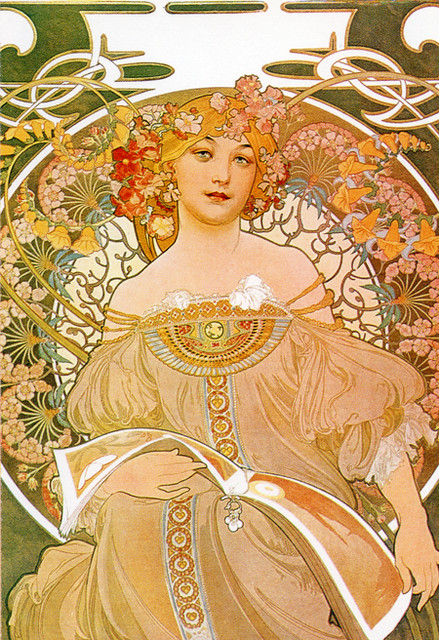
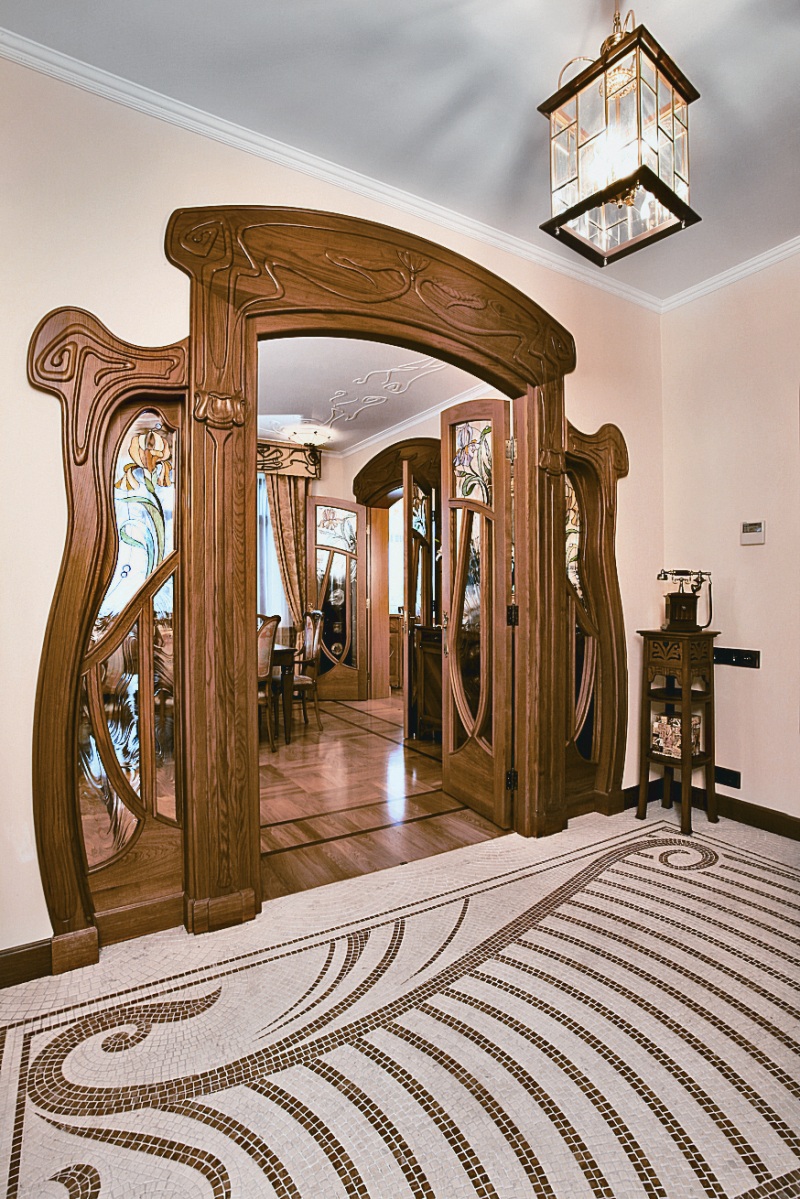
The Art Nouveau time period started in the late 1880s and lasted until about 1915. It was largely influenced by a call back to nature. Architecture to art to jewelry were all by products of this trend. It is often characterized by large, ornate scrolling, muted colors, nymph or fairy-like dramatization of the female form, flowers, butterflies and dragon flies, and even arched doorways and decorative molding in architecture. An immediate example of this can be seen in stained glass Tiffany lamps. These are some other examples of its influence:


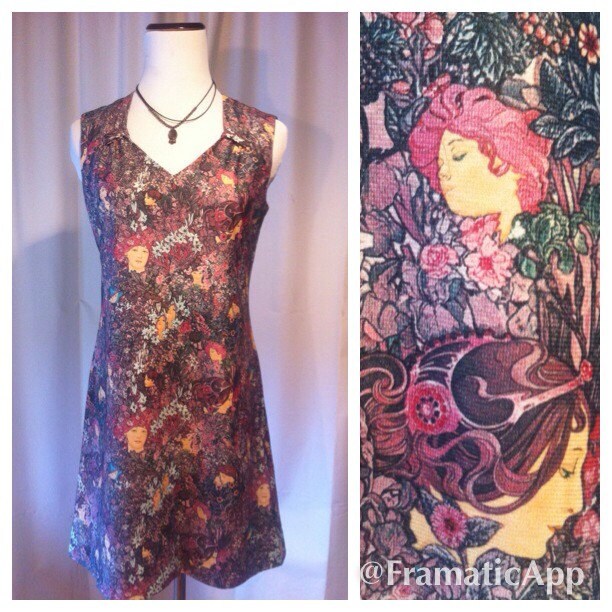
There was some revival to this style in the very early 1970s with the rise of the bohemian (boho) movement. Concert posters relied heavily on this style.


I recently sold a dress that was made during this later time period. The fabric and style are a wonderful representation of how these two time periods influenced each other. More pictures can be seen here.


Often, Art Nouveau and Art Deco are interchanged. I think it is most likely due to their close proximity in time frames. There is a very stark difference between the two as you will see below.


Art Deco

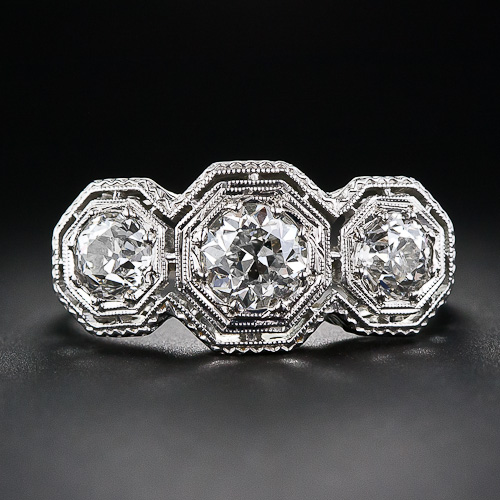
Art Deco arose with the rise in industrialization at about the time of World War I (1914). Where Art Nouveau was influenced by nature, Art Deco was influenced by the Industrial Age and lasted until the early to mid 1940s. It can be characterized by its bold streamlined stacked and cascading geometric shapes, rich colors, and its celebration of luxury with uses of stainless steel and chrome. Again, influences can be seen in architecture, art, jewelry, clothing, and anything else from this time period. Prime examples are seen in the Chrysler and Empire State buildings in New York City.


More examples can be seen in other items from this time period.


In art and fashion, where Art Nouveau rounded a woman's figure, Art Deco narrowed and elongated the female form. Hem lines rose and waist lines dropped. Corsets and petticoats were out and were replaced by under slips, camisoles, tap pants, and a combo cami/tap pant called a 'step in'.


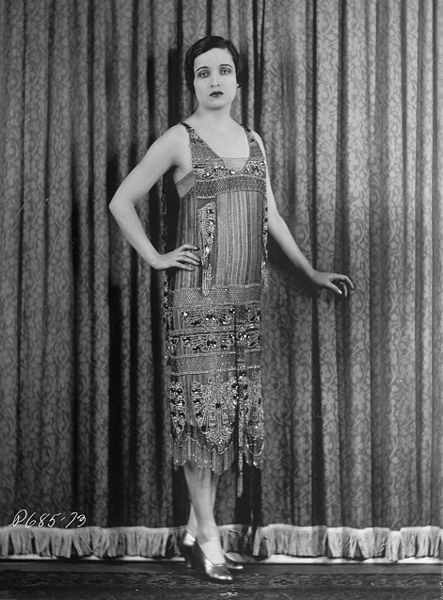
Ford had produced his Model T, and for the first time in history, people were on the go like never before. It was a time period vastly different from its predecessor just a decade earlier. Egypt and the rest of the world saw the opening of King Tut's tomb in 1922. Fashion celebrated in what is termed as The Egyptian Revival with elaborate beading and Egyptian motifs.


Elaborate lifestyles and excess, despite Prohibition (1920-1933), were admired as this was an age where anything seemed possible. The Jazz Age was formed, a risqué new form of music. No one saw more liberation during this time period more than women. The 19th Amendment to the Constitution gave them the right to vote in 1920. It was certainly a time to celebrate! They don't call it "The Roaring '20s" for anything less than what it was!

Women took more personal freedoms with the most revealing clothing to date and short 'bob' hairstyles. The 1920s silhouette was a simple one, but this time period is known for its elaborate embellishments such as beading, appliques, and softly layered fabrics such as silk chiffon and satin.


Sadly, most of these dresses have not been able to stand the test of time. Heavy beading on chiffon is just too much weight for such a fabric to hold up. A lot of sewing was completed by hand, and thread and fabric of this time was not as refined as it is today. Bathing, also, was not as prevalent as it is today. If you find one of these dresses, it will most likely have holes, loose beads or strands, or stains that won't come clean.

This most prosperous time lasted up until Black Tuesday in 1929 which threw the economy and the US into turmoil, to such an extent that it has never been forgotten. This is where I will pick up in the next segment.

Tuesday, June 2, 2015

A Brief Fashion History Part 1: Victorian vs. Edwardian

The Age of Queen Victoria

Women's fashion first came into light during Queen Victoria's rule from 1837-1901, otherwise known as the Victorian Age of fashion. Before this point, men's fashion was at the forefront. This time period is known for two distinct silhouettes: the hoop skirt and the bustle. I won't go into lengthy details as to all the subtle changes that happened during this 60+ year time period. If you would like to read more, Truly Victorian has an array of information that goes into much greater detail.

  • The Hoop Skirt - a large full length skirt with a close fitting bodice. Think of the southern belle or The Civil War (c. 1860s).
 

Laced up corsets, petticoats, bloomers, camisoles, and a large bird-cage like hoop all formed the fundamental shape of this look. These hoops were often made of wire and whalebones. Everyday wear would just consist of free flowing petticoats, while more formal events would require the hoop skirt.


  • The Bustle - In the early 1870s, silhouettes started to slim down with a slender front and the majority of fabric and drape were moved to the back of the skirt. The cage hoop skirt was transformed to a smaller version of itself. This was the only undergarment to change.
This style continued to evolve up until the very early 1900s with silhouettes becoming slimmer and slimmer.
 
 
The Age of King Edward VII 
 
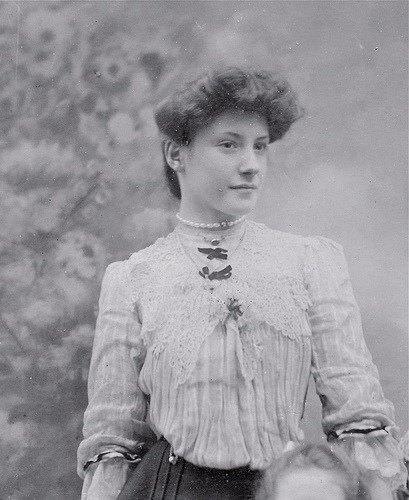
The Edwardian period was marked with the crowning of King Edward VII and ran from 1901 until roughly 1919. King Edward died in 1910, and there is some debate as to when this trend ended. Some believe it was around the sinking of the Titanic in 1912, while others believe it to be the start of World War I in 1914. Others believe it to be as late as 1919. For our purposes here, I'm sticking with the date of 1919.
There are two distinct silhouettes in this short period of time: The formation of the S-bend corset, and the later empire waist column.  

  • The S-Bend Corset - as the bustle accentuated a woman's rear, this corset would be tightly laced at the waist, forcing the hips and rear back and the bust was pushed forward. Also referred to as 'the pigeon', his silhouette was accentuated by very high necklines and looser fitting bodices and blouses. Thankfully, for most women, this trend only lasted until the late 1900s to very early 1910s.


  • The Empire Waist Column - lastly, this style was formed with a longer corset, like down to the knees lower! Necklines were dropped and waistlines were raised. The silhouette was the most slender it had ever been.


In the next segment, I'll discuss the period and differences between the Age of Art Nouveau and Art Deco which will cover The Roaring 20s!


Monday, June 1, 2015

Antique and Vintage Estate Sale Finds - May 30, 2015

I LOVE LOVE LOVE a good estate sale! We had a nice one in Canyon Lake over the weekend with lots of mid-century and older items up for grabs. I'll be re-selling some of these items, and some items I think I may keep.

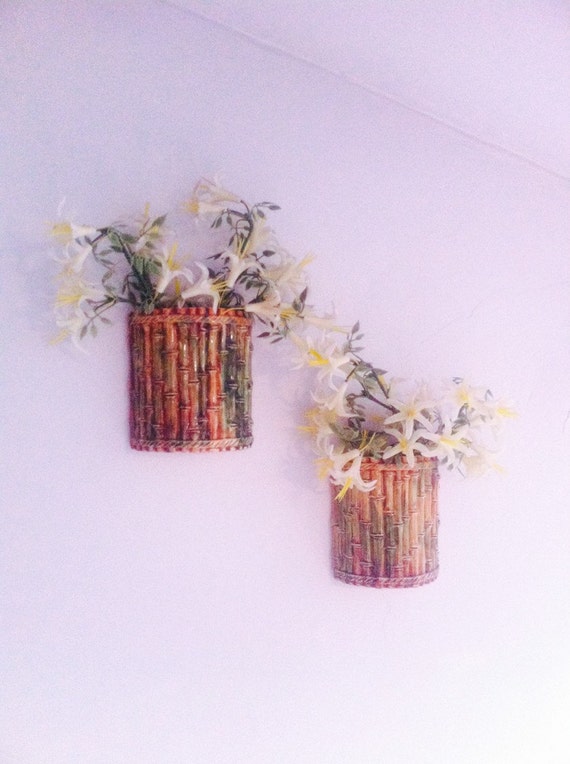
These are some 1960s ceramic sconce vases that are super kitschy! You can find them for sale here.
Made in Japan, they would be a wonderful addition to any tiki or safari themed room.


I always look for old sewing notions, patterns, and fabric when I attend one of these events. This is a lovely little antique brass pin cushion from the late 1890s to early 1900s. I haven't decided if I'm letting this one go.


Another fabulous find was this 1940s/1950s Mexican hand painted, hand carved batea wood bowl. Despite the picture, the colors are vibrant and beautiful!! I'll be listing this one in the near future, and update here when I do.


I have always loved interesting clocks.This is an awesome 1950s atomic style bed side clock made by The Hollis Press and Underwriters Laboratories. UL was known for lamps and lighting, so it should be no surprise that it even has a night light option that illuminates the bottom right rectangle. This will most likely be a keeper, but I had to show it off!!


Interesting kitchen items are also a passion of mine. Often, a woman's kitchen was a reflection of her skill and taste. I know many women would find such ideals as degrading or anti-feminist, but I find it quite the opposite. A woman could express creativity in the kitchen, and it was her domain to wield and foster control of her household.

These are a few of items I was able to snag

Here is a Betty Crocker recipe box from 1971. The recipe set is only half complete, so I will not be listing it. Nonetheless, my husband will be most happy with my attempt at some of these goodies. I have seen some of these boxes on Etsy, and if interested, you can find a complete set in a variety of colors very reasonably (avg $20)!


Another find was this anodized aluminum rolling pin. It is a very nice weight, and would look great in any stainless steel style kitchen! It is currently for sale here.


This is one of a set of four late 1960s serving trays. Loving the daisies! Now listed here!
 

A lot of home décor and house hold items in the early to late 1960s were made in Japan. As such, items from this time period had Oriental influence and motifs. I'll expand on this trend in a future post. For now, this little vase is a great representation of its time period. I will update as soon as this item is listed.
 

The Mod style emerged in the mid 1960s and lasted until the very early 1970s. A large part of this style were items made out of the dark wood walnut. Again, this will be expanded on in a future post. This little ashtray caught my eye as it was a vacation souvenir. Elaborate vacations, such as that to Jamaica, weren't as common as they are today. Most people would take road trips because it was more affordable and accessible rather than flying to a destination. This little ashtray even has a Jamaican half penny coin from 1940 embedded in the wood.
 
I hope to have most of these items listed within the month. I will update each when I do. If you have any questions about one of these items, feel free to comment below.